Should Pastors and Christians Trust Mental Health Therapists?
I recently ran across a podcast clip from Josh Howerton at Lakepoint Church in Dallas, TX, where he tells his listeners that therapy may not be doing what we hoped it would do during it’s 100+ years of operation. He advises his listeners to make sure they’re getting wise, Godly counsel from a counselor - and I agree, sort of. I have heard things like this from pastors most of my life, “Be careful,” but what they don’t do is tell people how to be careful. This bugs me.

Imagine for a moment that you take a person out of a sprawling city that they’ve lived their entire lives and drop them into the Texas wilderness. Your only advice is, “Be careful.” BE CAREFUL OF WHAT??? Well, in Texas we have poisonous snakes and bugs, poison Ivy, poison oak, and that neighbor’s long horn bull is NOT to be trifled with. He’s always angry. Given a choice, I’m sure this person would prefer counsel before being dropped in the wilderness. For most Christians, the medical and therapeutic world is the wilderness.
To Josh’s credit: He does try in the podcast to tell his listeners that good therapy does exist. His guests discussed their positive outcomes with therapists and therapy. This is the link to the entire podcast.
Josh discusses who might need to go to therapy in the full podcast, and he’s absolutely right. If someone is emotionally reacting today out of something that happened in the past and they cannot stop reacting in this way even if they want to; they need therapy.
Why aren’t we getting better in our therapeutic culture?
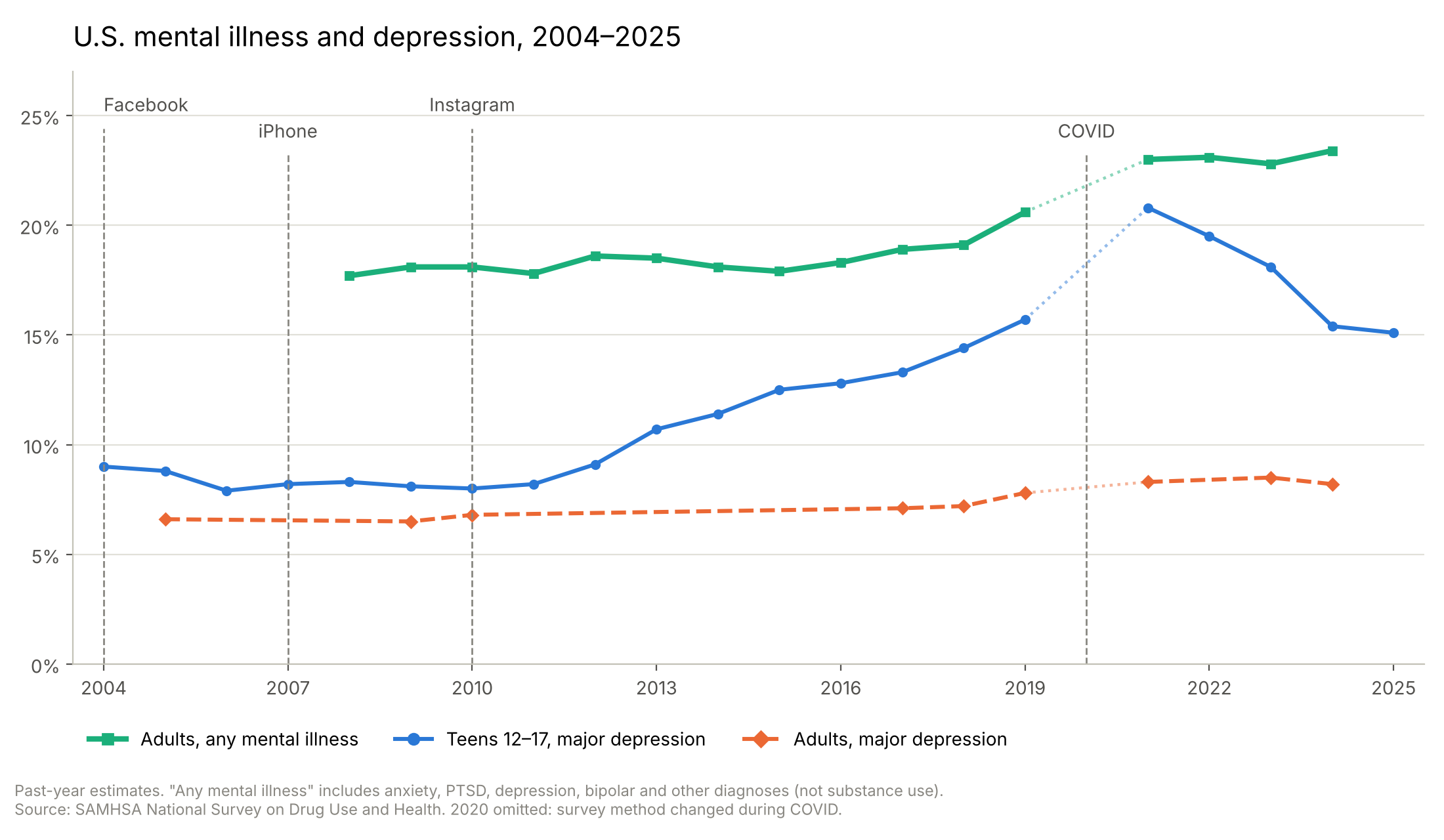
Correlation does not mean causation. Yes, everyone is more anxious and depressed overall today than we were 20 years ago. Adult mental illness of any kind held around 18% through 2016, then rose to 23.4% by 2024. That's roughly 1 in 4 adults. The rise is sharper for severe cases. Adults with serious mental illness went from 3.7% in 2008 to a high of 7.8% in 2024, about double. The thing that every parent should be terrified of though is the rate of teen mental illness and suicide since 2012. 2012 is the marker where the majority of teens had smart phones and access to social media. I still believe our smart phones are causing much more harm than good to our mental health and the mental health of our children, but I digress.
The problem isn’t bad therapy. The problem is going to therapy at all. The number one reason people don't get help is they think they should handle it on their own, and nearly half of evangelicals believe prayer alone is enough. Among untreated adults who felt they needed help, 72.9% said they thought they should manage it themselves.
The top three reasons people report NOT going to therapy
Thought they should handle it on their own: 72.9%
Thought it would cost too much: 61.4%
Couldn't find a provider or program they wanted: 43.2%
What about Christians?
Practicing Christians were half as likely to seek counseling for mental illness: 15%, compared with 33% of non-Christians. Mostly because there is a stigma in the church that still lives on today causing people to avoid the help they so desperately need. When Christians did go to therapy, they liked it more: 54% rated it very positive, compared with 36% of non-Christians. Only 14% of Christians who went to counseling said a pastor's recommendation got them there.
I would challenge any Pastor or Care Team to have referrals on hand for your congregation. You should know your people and be connected in their lives in such a way that if they were to show up to therapy it is because the Church recognized the need and directed them to safe places to go. You should have a care scholarship or fund available for your people to use for therapy. If you’ve partnered with places like The Hope Place, your budget allows for your congregation to receive help quickly in a completely confidential way AND you have effectively bypassed the 3 reasons people don’t go to therapy.
How to Tell the Difference Between “Good and Bad Therapists” for Christians and Pastors
There is quite a bit of time spent in the podcast discussing how therapists have become “secular priests” and that they are replacing pastors. Josh also warned fellow Christians that by going to therapy you are asking to be discipled by this person. This entire notion is incorrect. No offense, Josh. Let me explain.
Are They Licensed by the State of Texas?
Coaches help you move forward and give you advice. Mentors share what they've learned. Licensed counselors and therapists treat what's holding you back neurologically, and should not be giving advice to their clients. When there's trauma, depression, anxiety, or risk of harm, refer to someone with a license you can look up. I know this is confusing, but in Texas there is a licensing board for mental health called the Texas Behavioral Health Executive Council (BHEC.) This is the state’s body that governs who is allowed to be a therapist and what they’re allowed to do.
Texas has four boards under the Behavioral Health Executive Council (BHEC), plus a separate system for substance use counselors. Here are the license types under each:
Professional Counselors: LPC-Associate: master's done, practicing under supervision, LPC: Licensed Professional Counselor, independent practice, LPC-S: Supervisor designation, can supervise associates, LPC-AT: Art Therapist designation added to an LPC. I am personally an LPC-S.
Marriage and Family Therapists: LMFT-Associate: under supervision, LMFT: Licensed Marriage and Family Therapist, LMFT-S: Supervisor designation
Social Workers: LBSW: bachelor's level, non-clinical, LMSW: master's level, clinical work only under supervision, LMSW-AP: Advanced Practitioner, non-clinical leadership or policy,
LCSW: Licensed Clinical Social Worker, independent clinical practice, LCSW-S: Supervisor designation
Psychologists: Licensed Psychologist: doctoral degree, independent practice, Provisionally Licensed Psychologist: doctoral degree, finishing requirements, Licensed Psychological Associate (LPA): master's level, supervised, Licensed Specialist in School Psychology (LSSP): works in schools
Substance Use (Texas Health and Human Services, not BHEC): Counselor Intern: in training, LCDC: Licensed Chemical Dependency Counselor, CCS: Certified Clinical Supervisor
Prescribers (not counseling licenses, but they treat mental illness): Psychiatrist (MD/DO): Texas Medical Board, Psychiatric Nurse Practitioner (PMHNP): Texas Board of Nursing
Who can independently diagnose and treat: LPC, LMFT, LCSW, Licensed Psychologist, and prescribers. LCDCs treat substance use. Associates, LMSWs, and LPAs treat clients under supervision. So of all the types of licenses out there you want to make sure that the person you are sending to therapy is licensed AND has the training and ability to diagnosis.
IF THEY’RE NOT LICENSED, DO NOT REFER TO THEM FOR MENTAL HEALTH TREATMENT
The podcast discussion about being mentored and discipled by a therapist is a tough one. If a therapist is telling people what to do or giving advice about their situation, that’s not therapy. That’s a red flag.
Does the Therapist have to be Christian?
I may get some pushback on this, but I would argue that NO, the therapist does not have to be Christian to do God’s work. If you are Christian, you believe that truth is owned by God. There are biblical principles and truths about mental health healing that are practiced today by therapists of any and all faiths. How many people in the bible were used by God for his purposes when the person was not worshiping him? So many. Instead of landing on a decision as to whether or not the therapist is Christian, I would instead look at the type of therapy the therapist provides. For more information about the differences between a biblical counselor, a therapist that’s a Christian, and a Christian Therapist - read this blog.
Do they use Systemic or Individual Models of Therapy?
There are major differences in modalities across therapy professionals. I generally recommend that someone who claims to be eclectic may not be mastering any certain type of therapy. They may be hopping around schools of thought, which could keep clients in sessions longer than necessary. Our brains are like finger prints. We are all fearfully and wonderfully made to be individuals with our own strengths and purpose. There is not one therapy modality that will work perfectly for every person; however, there are models of treatment that are generally more respectful of each person’s gifts.
There are also differences within these models about what causes change, what happens to create change, and how change relates to the individual or a system.
We were not created to be alone.
There are two types of models within therapy. Individualistic and Systemic Models of treatment. It is my view that individualistic models of therapy are focused inward to the self. The table below was created to explain the differences between models like Solution Focused Brief Therapy and Individualistic models like Cognitive Behavioral Therapy and DBT.
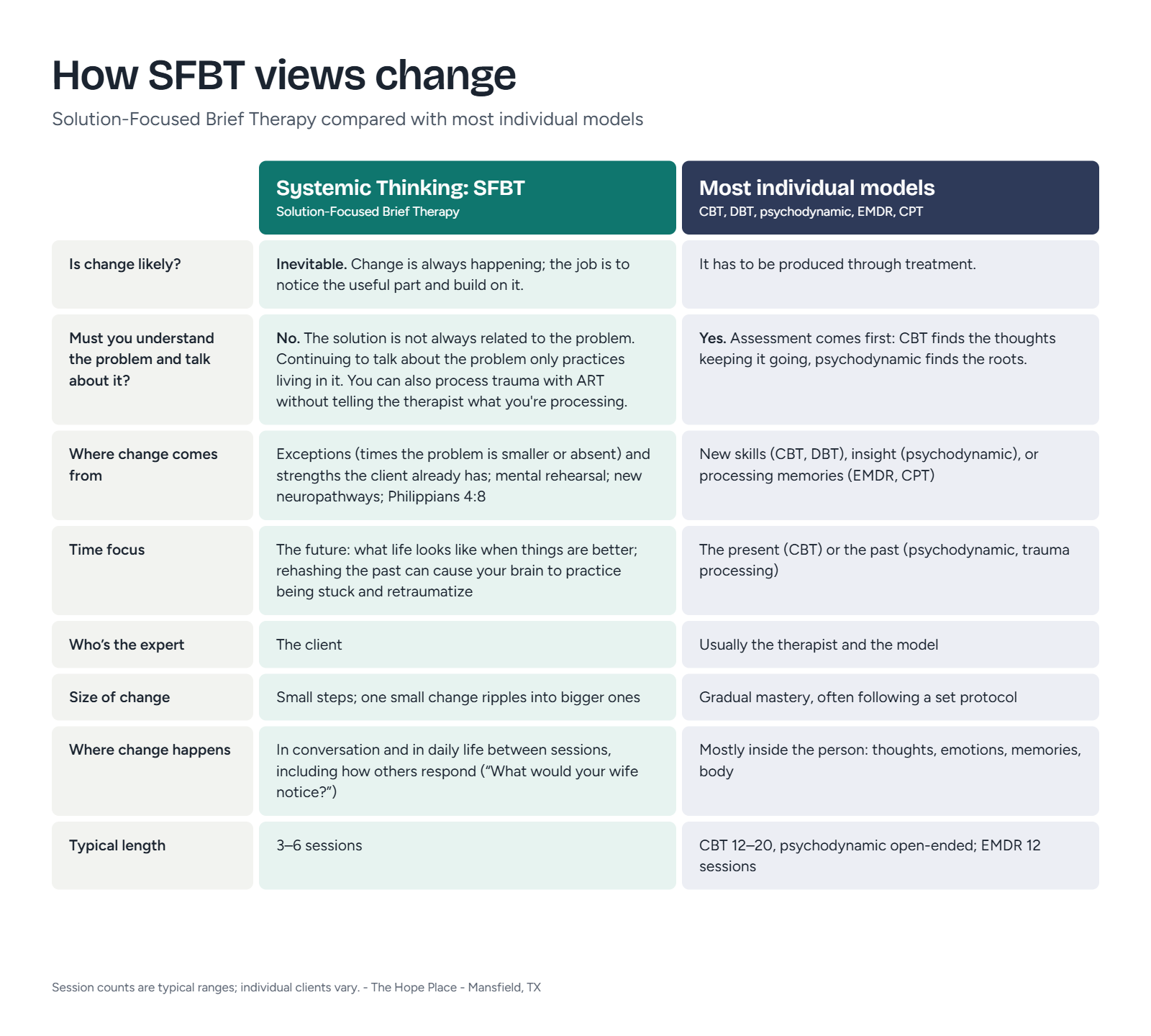
Close to 80% of therapists in the DFW area are CBT therapists. They have lots of lobbyists, and their treatments are geared to satisfying insurance check boxes. You are not a check box. CBT has been around since the 1960s while SFBT was formed in the 1980s. There is a giant body of evidence showing that SFBT is as effective as CBT with half the time. More importantly though, the essence of SFBT is that of humility, curiosity, metaphor, and love for our clients. We believe that they have everything they need to overcome their problems, including their faith, but they just haven’t taught their brain how to do it yet. We are not the experts in their lives. We translate and we do not tell them what to do. We don’t even define what better is to them. We ask the questions to help them define it. God designed hope as a strength for us to persevere. He didn’t tell us to run the race without giving us the legs to do so. We help people discover their legs again. We teach their brains how to live out Philippians 4:8 by asking specific questions about what is beautiful in their lives including the systems they live in. The problem is not always related to the solution.
What Josh was referring to in his podcast were Individualistic models of treatment. They do tend to focus inwardly on your thoughts and about your being and self, and this is not biblical for healing. It is better to give than to receive. Acts 20:35 It is better to focus outwardly than inwardly. If God created us, he knows how we should live to be our best selves, and that is within a system. Christians should choose therapists that have mastered Systemic Models of Therapy.
Is the Treatment Orderly or Chaotic?
Therapy should have a treatment plan. If you feel like you’re going to your therapist just to vent, that’s not therapy. Venting is not therapy. Yes, of course, there may be times where the therapist needs context to a experience that you’ve had, but only to find the exceptions to the problem and it shouldn’t take the whole session to update context. The same argument applies to any treatment that involves “free association.” God is a God of order, not chaos. 1 Corinthians 14:40 Treatment should be completed in a fitting and orderly fashion.
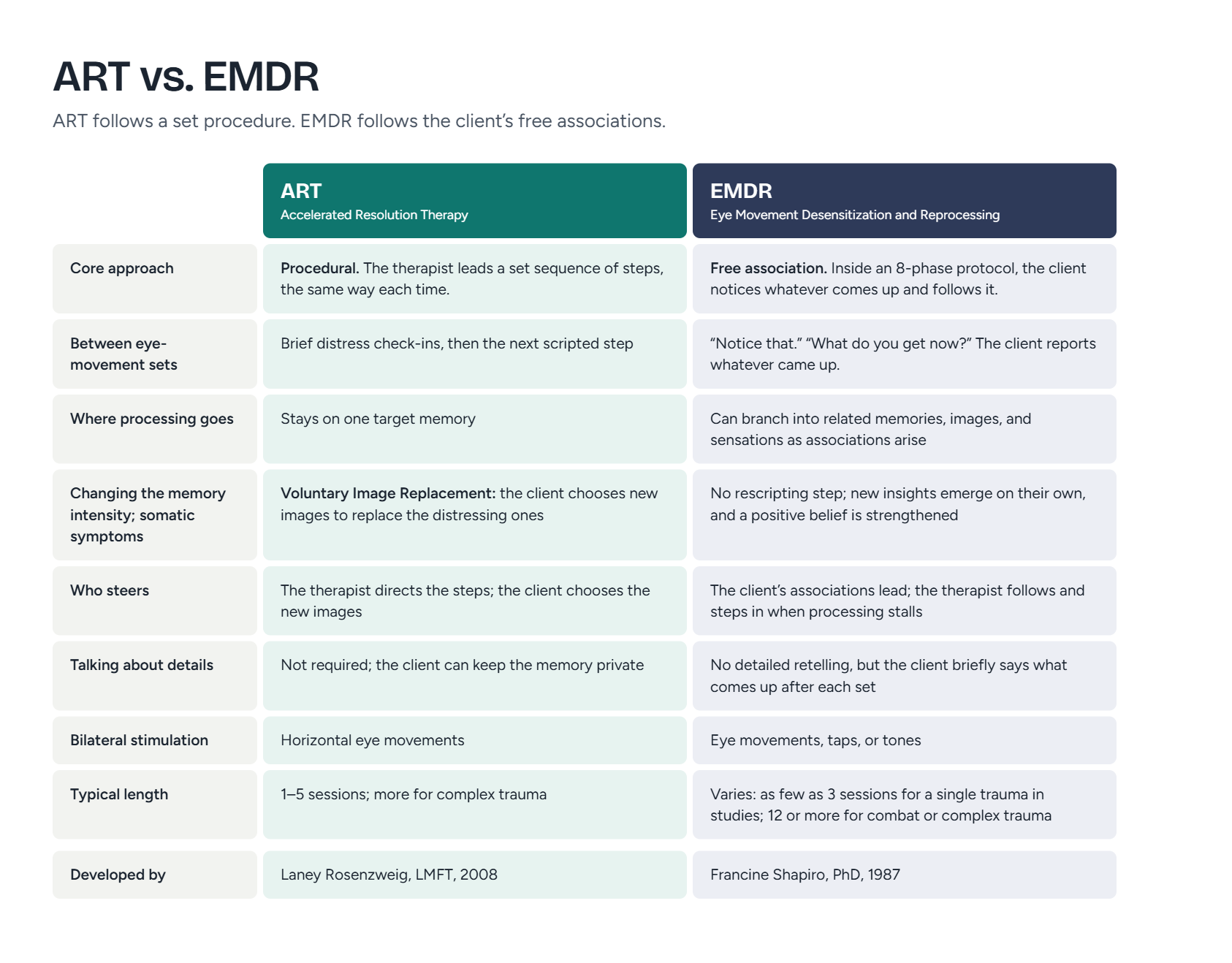
Treatments that involve associative elements can feel very painful to complete. Unnecessarily so. As a therapist, I’ve heard the whole, “It’s gotta get worse before it gets better,” and honestly, that’s not a biblical principle. Being a new creation is biblical. Waking up every morning with brand new brain cells being part of God’s mercies to us is biblical. Allowing those brain cells to make permanent connections based on how we use them is biblical. EMDR is one of the trauma treatment models that I would avoid, specifically because they really do make things worse before they get better. I received EMDR and after only a couple of sessions had to drop out because it was leaving me more raw and emotional than it was helping to process the trauma I had experienced. I wrote a whole blog on that too if you’d like to see the differences in my personal experience.
If the person you need to refer is struggling with a trauma from betrayal or other incident; that means that their brain has fundamentally changed how it operates. But God gave us a way forward. Using God given eye movements that we use naturally while we sleep, accelerated resolution therapy is able to process the negative thinking loops, traumatic events, or phobias in 1 to 5 sessions as compared to EMDRs 12. Why? Because it’s procedural. It’s orderly. The brain works with order and metaphor.
A Call to Pastors
God made psychology, we’re just trying to understand it. He created our emotions and our bodies, and there are very real fail safe reasons that people experience mental health episodes. Knowing you’re safe and feeling safe are entirely two different things. Someone may repeatedly take their anxieties to the cross only for their body to betray them. It’s much more complicated than not having enough faith. Yes, the bible tells us how to live and what to focus on - but therapists are for people who can’t even get their bibles open because nothing is worth the effort it would take to continue living.
Yes, Christians and Pastors should trust mental health therapists, but choose wisely by asking questions.
What is your license? (LPCs and LMFTs receive far more counseling hours than Social Workers in training)
Do you use a systemic or individualist model of treatment?
May I incorporate my faith into sessions with you?
Do I have to talk about what’s bothering me?
Will we make a plan and set goals for treatment?
Found this helpful?
If you’d like someone from our office to reach out, leave your details and we’ll get back to you. No obligation, and nothing is shared.
Thank you — we’ll be in touch.
If it’s urgent, call or text us on 817-941-0100.
Sources: