
"Show Me, Don't Tell Me"- Sandtray Therapy for Adults and Kid.
My first introduction to a sandbox was sometime between the age of 2 and 8, my memories associated with a particular house we were living in. I remember the feel in my hands, and all the different ways my imagination could use it. I also remember learning the significance of putting the lid on tight, lest a rogue cat misunderstood the intent and decided it was a litter box.
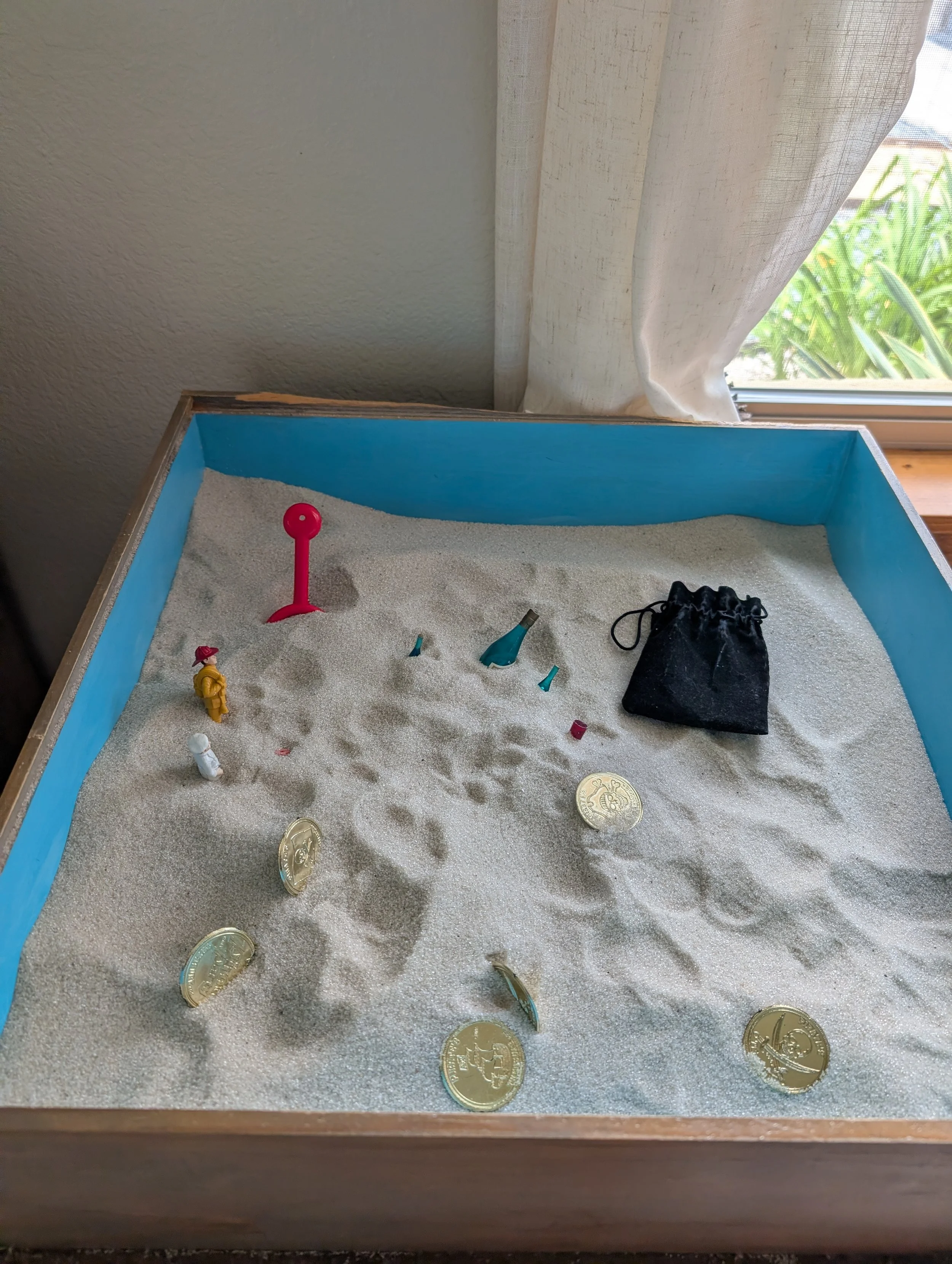
While my interactions with sand trays look different today than they did as a child, the love is still present. As a therapist, I love the versatility that a sand tray offers, and the fact that there is much research around it. As an individual that appreciates utilizing both sides of my brain, I love how a good sand tray can tap into both hemispheres.
As a therapist that has worked with trauma much of my career, I have found the magic of sandtray to benefit not just children, but adults as well. As adults, we can get in our own way at times, and there is something inherently different that the brain processes when the words “show me” are used instead of “tell me”. While one might think that these could be used interchangabley, I have experienced time and time again that the opposite occurs.
When the brain is asked to creatively communicate, the cognitive initial “first response” that occurs in talk therapy may look different when asked to “show me”. This is because the right hemisphere engages the limbic system, which produces symbols, implicit memory, and nonverbal experiences. “ Showing me” allows the client to express complex, abstract feelings without the immediate pressure to translate them into linear language.
While I will never be my own therapist, utilizing a sandtray and a solution focused approach for myself has been a great addition to journaling. I have found it highly beneficial for those times when an emotion has been strong and real, but the evidence surrounding the reasoning behind it is shaky at best. ( I know I am not the only one that experiences these things). Instead of focusing on the emotion itself, a verbal command of “ what are your best hopes in this situation” often fill in the gap for my confused logic and swaying emotions.
Sandtray can be a powerful intervention, and is welcome with me, whether one is young or old. I would love to meet you!
Rachel Nauss is a therapist at The Hope Place that sees children and adults. She is a Registered Play Therapist with Texas and is our COO at The Hope Place.
